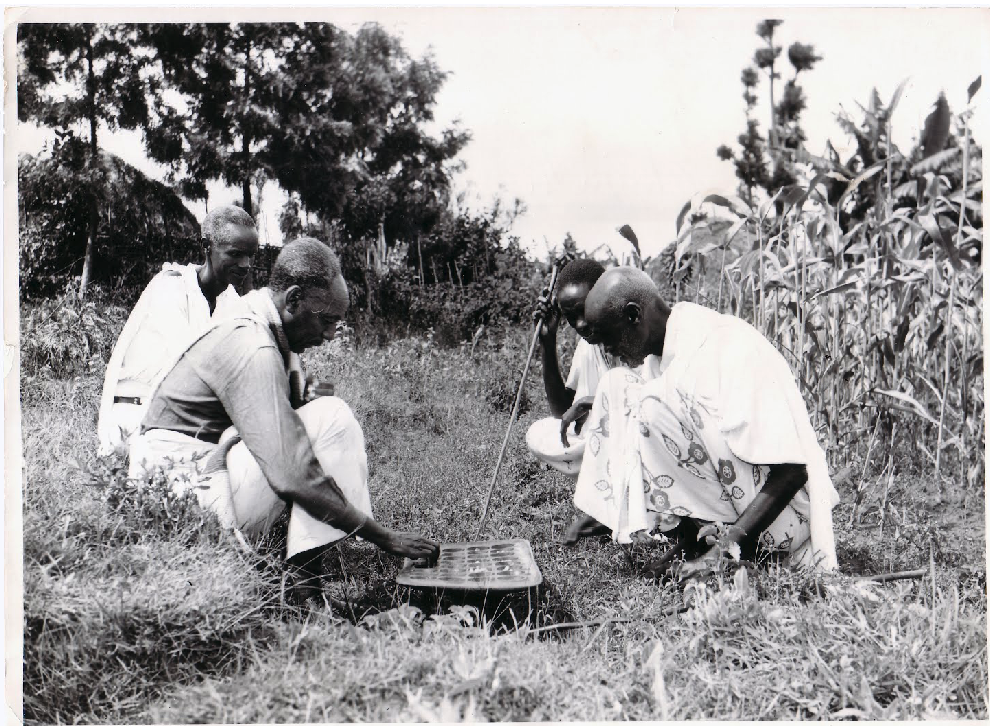
I’ll begin this blog by stating a painful truth: Games are not Important. We enjoy them but in the larger scheme of our lives, there is always something more useful we could be doing.
In May 2026, The New Times reported that cultural officials want to promote igisoro, at a time when many young people are turning to digital games. Experts fear this is weakening social interaction, critical thinking, and community life. I take that worry seriously.
I am an indie game developer, and I want to see games become part of Rwanda’s creative economy. So in this post I will do two things. First I will take igisoro, our traditional board game, and test it against the way game designers define a game, to show what a game looks like at its best. Then I will look honestly at games at their worst, and at what makes the difference.
“The Goal of all entertainment experiences is to take something unimportant and make it seem very important indeed” - Jesse Schell
Play was how we learned
Long before classrooms, Rwandan children learned by playing. Adult skills had child-sized versions. Archery, for example, became a game: children used a small bow and arrows to shoot at a moving target, such as a banana. It was play, but it was also practice for a skill they would need later.
Girls played with dolls, umwana. The doll could be as simple as the last flower bud of a banana plant, carried and cared for like a real child.
These games were safe places to rehearse life. Today a game designer would call that a sandbox.
What is a game?
Game designers have argued about this for decades. In The Art of Game Design, Jesse Schell gathers several well-known definitions and pulls out the qualities they share. I will borrow three of those definitions and his approach, and check each quality against igisoro.
“[A game is] an interactive structure of endogenous meaning that requires players to struggle toward a goal.” — Greg Costikyan
Greg Costikyan: struggle, interaction, and meaning from within Costikyan describes a game as an interactive structure, with meaning that comes from inside the game itself, in which players struggle toward a goal.
- Games are interactive. Every move I make in igisoro changes the board my opponent has to answer. Nobody plays it by watching.
- Games have challenge. One sowing can chain across the whole board, and strong players count several moves ahead. That mental struggle is the game.
- Games create their own value. Off the board, the seeds are just seeds. On it, a full pit feels precious, and losing it hurts.
“Games are an exercise of voluntary control systems, in which there is a contest between powers, confined by rules in order to produce a disequilibrial outcome” - Elliot Avedon and Brian Sutton-Smith
Avedon and Sutton-Smith see a game as something people enter voluntarily: a contest between opposing sides, bounded by rules, that ends with the sides unequal.
- Games are entered willingly. Nobody is forced to play igisoro. Two people sit down because they choose to, often after one challenges the other.
- Games have goals. Capture your opponent’s seeds until they have no move left.
- Games have conflict. Every seed I capture comes straight out of my opponent’s rows. My gain is their loss.
- Games have rules. The sowing, the chains, and the captures are fixed. They are what make the Rwandan version so demanding.
- Games can be won and lost. When one player cannot sow, the game is over and the other has won.
“A game is a closed, formal system, that engages players in structured conflict, and resolves in an unequal outcome.” - Tracy Fullerton, Chris Swain, and Steven Hoffman
Fullerton, Swain, and Hoffman define a game as a closed, formal system that draws players into structured conflict and ends in an unequal result.
- Games engage players. Watch a serious match and you will see silence, focus, and spectators leaning in. People argue about who is winning long before the end.
- Games are closed, formal systems. Everything igisoro needs is on the board. The number of seeds never changes. Seeds are moved and captured, never created. It is a complete little world.
Igisoro passes every test. By the standards of modern game design, a board game our ancestors played is as much a game as anything on a console.
The Dark Side
Igisoro shows a game at its best. Not every game is like it, and it would be dishonest to stop here.
Games built to hook you
Some games are designed to keep you playing long after you have stopped enjoying them. Daily login rewards punish you for taking a day off. Timers and streaks pull you back on the game’s schedule instead of yours. Levels are tuned so that the next reward always feels one more round away. The World Health Organization now lists gaming disorder as a recognised condition. Most players never get near that point, but the designs that push people toward it are deliberate.
Games built to make you pay
Many games are free to download and expensive to play. Loot boxes sell you a random reward for real money, which is close to gambling and is treated that way by regulators in some countries. Other games make progress slow and tedious on purpose, then sell you the shortcut. This matters more when the player is young, and more again in a country where that money is hard to come by.
Playing alone, on someone else’s terms
A game can connect people. It can also replace them. Hours spent alone against strangers or an algorithm are hours not spent with family, friends, and neighbours. And almost every game young Rwandans play was made somewhere else. The heroes, the cities, and the stories are someone else’s. That is fine in small doses, but a generation raised only on imported worlds may forget it has stories of its own.
What decides the difference
The designer decides first. Every game answers a question, whether its maker admits it or not: is this built to give the player something, or to take something from them? A game that respects your time and your money looks very different from one that is built to drain both. Players and parents decide too. A few questions sort most games quickly:
- When I stop playing, do I feel satisfied or just tired?
- Does the game let me stop when I want to, or does it punish me for leaving?
- Am I paying for something I value, or paying to end an annoyance the game created?
- Am I playing with people, or only near them?
No game is good for you at eight hours a day. But a well-made game in a balanced life is no more dangerous than a good book or a football match.
Sources
- Jesse Schell, The Art of Game Design: A Book of Lenses. 2nd edition.
- Frank Ntarindwa, “Igisoro board game ‘could become a tool for cultural diplomacy’”, The New Times, 22 May 2026.
- Rwanda Cultural Heritage Academy, “Igisoro: The Two Player Board Game”, Google Arts & Culture.
- WHO, Gaming disorder, https://www.who.int/standards/classifications/frequently-asked-questions/gaming-disorder